

Working together for the best combination of skills
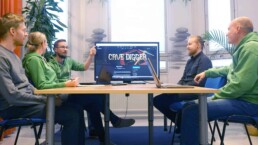
Collaboration between companies allows you to build a team for each project that can best meet your needs. This creates good conditions for learning and ensures future competitiveness. The profitability of projects will also improve.
Cooperation produces better innovations. In particular, technological cooperation increases the likelihood that a small firm will succeed in innovation. Still, some studies show that small firms have fewer innovation cooperation than large firms.
Earlier this year, we published a blog about how the principles of open innovation have benefited MeKiwi’s development and growth. As we have been asked a lot about this topic, we will publish a series of three blogs where we explain on a practical level how we implement innovation cooperation.
In the previous blog, we discussed the search for a business opportunity. In this section we describe the implementation phase of the project and in the next section we move on to the market entry phase.
The social network is an important vehicle for knowledge
One of the key principles of open innovation is to understand that not all the top people in the industry work in your own company, even if you are proud of your own team. We also want to work with talented people outside the company. It expands opportunities to pick up different projects and develop them. This situation has already been considered in the search for a business opportunity.
The Oulu Game Lab has been the main source of internal skills development for MeKiwi. In addition to growing the gaming workforce, Oulu Game Lab has been instrumental in creating many partnerships. This is where close relationships with game companies such as Kaamos Games and Happy Hobgoblin come from.
Another important source of knowledge is the social network of entrepreneurs and workers themselves. Through a social network, a connection was made with the game studio Reforged Studios, whose busy backlog just happened to fit MeKiwi's need. This working relationship was also mediated through the network.
"I shared my concerns about resource adequacy with the right person. He happened to know that Reforged Studios has some free time between two of their projects. A small tip had a big impact when MeKiwi was able to complete its own team in a strategically important project," says Jonna Ranta, Customer Success Manager at MeKiwi.
In a true cooperation, all parties learn
Some partnerships are based on contracts, but resources are also shared informally with close partners. MeKiwi was one of the companies studied in a Master's thesis on the innovation process of start-up companies at the faculty of Economics of the University of Oulu. The surveyed start-ups reported that they shared resources such as documents, technology, graphics and equipment during the project implementation phase. Interviewees also reported cooperation in sharing knowledge and skills, either through discussion or by lending employees to another company's project. Traditional subcontracting is also used. MeKiwi recognises most of these. Sharing resources improves the profitability of projects, but reducing costs is not the only reason.
"Using external resources enables us to bring together the best combination of expertise for each project," explains Jonna Ranta. "This of course benefits our customer".
With the help of external expertise, you can always reach a little higher by learning things that will be useful later on. "We always look for situations where everyone benefits from cooperation," says Jonna Ranta. "This will secure the future of the business. And it's nice to work in a good atmosphere!"
If you want to hear more about how winning teams are built, just give Jonna a call. Jonna is happy to talk about project management issues. Jonna's phone is 050 307 6756. Let's have a chat!
Background of the study
MeKiwi was one of the companies surveyed in a study conducted as part of the Innovation Alliance's Accelerating Operations project, which also included a master's thesis entitled “The Innovation Process of a Startup Company in a Regional Innovation Cluster”. The key finding of the study was that start-ups can benefit from the regional innovation ecosystem at all stages of their innovation process, both by using innovation support services and by establishing meaningful networking relationships. The study divided the innovation process into three stages according to the customer-driven Design Thinking innovation process model. In this series of three blogs, we describe how we implemented the principles of open innovation in line with these three stages.
Sources:
- Brown, T. (2009). Change by design: How design thinking can transform organizations and inspires innovation. New York (N.Y.): HarperBusiness.
- Chesbrough H. (2003) The era of open innovation. MIT Sloan Management Review; 44:35–41
- Nieto, M. J. (2010). Technological Collaboration: Bridging the Innovation Gap between Small and Large Firms. Journal of Small Business Management, 48(1), 44–69.
- Parida, V., Westerberg, M. ja Frishammar, J. (2012). Inbound Open Innovation Activities in High-Tech SMEs: The Impact on Innovation Performance. Journal of Small Business Management 2012 50(2), 283–309.
- Sydänmaanlakka, P. (2009). Jatkuva uudistuminen: Luovuuden ja innovatiivisuuden johtaminen.Hämeenlinna. Talentum Media Oy. 293 s.

Better innovations with cooperation
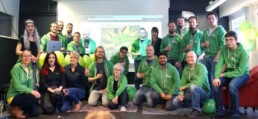
Cooperation produces better innovations. In particular, technological cooperation increases the chances of success for a small business. Still, some studies show that small firms have fewer innovation cooperation than large firms. In this new series of three blogs, we will talk of how collaboration has helped MeKiwi to innovate.
Earlier this year, we published a blog about how the principles of open innovation have benefited MeKiwi’s development and growth. As we have been asked a lot about this topic, we will publish a series of three blogs where we explain on a practical level how we implement innovation cooperation.
This first blog is about identifying a business opportunity. In the following entries, we will go from the project implementation phase to the launch of the product and the implementation and further development of the commissioned product.
Finding opportunities starts with getting to know people
For a start-up, the search for the first business opportunities is linked to the development of the company as a whole. In addition to the potential customer, resources are sought and identified. At this stage, the emphasis is on financial services and public services that support the development of business skills. MeKiwi has also made use of such services, for example by participating in game-related training courses organised by the Oulu University of Applied Sciences.
In practice, innovation cooperation in the business prospecting phase is about getting to know people and identifying opportunities for cooperation. Both the public sector and businesses provide opportunities for this by organising events such as training and networking events. Even informal events are very relevant to business. As Jani Kaipainen, one of MeKiwi's founders and Innovation Director, puts it: "you meet people and then you can make things".
To get things done, one of the resources you need to ensure is funding. Jani Kaipainen hopes that funding will be more visible in public networking events.
"There are plenty of and good ideas, but many seem to remain undeveloped because of a lack of know-how to find the resources. We should bring together users, developers and financiers from the very beginning," says Jani Kaipainen.
Knowledge flows both ways
Open innovation research shows that networks enable the reception and exploitation of information flows. The knowledge, skills, technical expertise, sharing of advanced technology and cooperation to meet market demands channelled through the network strengthen the competitiveness of the company and reduce costs. MeKiwi has integrated the benefits of the network and resource sharing by operating in shared premises throughout its life. The current address is the business community Njetwork Inn.
MeKiw's expertise in identifying business opportunities and starting up operations has been passed on to others by sharing at least experience, information, documents, contract templates, management expertise, financial know-how, networks and event tips, recalls Jani Kaipainen.
Information is also flowing to MeKiwi. In addition to business partners and customers, an understanding of the customer and the general situation in the industry can also be gained through public services. MeKiwi has successfully used events and projects in the Oulu innovation ecosystem to connect with end users. Projects such as Smart learning environments for the Future and CityIoT have provided opportunities to gain an in-depth understanding of users and environments. This has been used to develop educational technology solutions.
Help a friend whenever you can
MeKiwi's business focuses on emerging technologies such as virtual reality. This requires continuous updating of skills, but this alone is not enough. For example, in addition to technological know-how, educational solutions require a varying mix of multidisciplinary knowledge. It comes from a network of partners and a network of experts. According to Samuel Kuosmasen, CEO of MeKiwi, the opportunity to take on different development projects expands when you know that you can build a good development team. Good business relationships are built on good human relationships.
Background of the study
MeKiwi was one of the companies surveyed in a study conducted as part of the Innovation Alliance's Accelerating Operations project, which also included a master's thesis entitled “The Innovation Process of a Startup Company in a Regional Innovation Cluster”. The key finding of the study was that start-ups can benefit from the regional innovation ecosystem at all stages of their innovation process, both by using innovation support services and by establishing meaningful networking relationships. The study divided the innovation process into three stages according to the customer-driven Design Thinking innovation process model. In this series of three blogs, we describe how we implemented the principles of open innovation in line with these three stages.
Sources:
- Brown, T. (2009). Change by design: How design thinking can transform organizations and inspires innovation. New York (N.Y.): HarperBusiness.
- Chesbrough H. (2003) The era of open innovation. MIT Sloan Management Review; 44:35–41
- Crossan, M & Apaydin, M. (2010). A Multi-Dimensional Framework of Organizational Innovation: A Systematic Review of the Literature. Journal of Management Studies, 47(6), 1154–1191.
- Freel, M. S. (2005). Patterns of Innovation and Skills in Small Firms. Technovation, 25(2), 123–134.
- Parida, V., Westerberg, M. ja Frishammar, J. (2012). Inbound Open Innovation Activities in High-Tech SMEs: The Impact on Innovation Performance. Journal of Small Business Management 2012 50(2), 283–309.
- Rogers, M. (2004). Networks, Firm Size and Innovation. Small Business Economics, 22, 141–153.
- Sydänmaanlakka, P. (2009). Jatkuva uudistuminen: Luovuuden ja innovatiivisuuden johtaminen.Hämeenlinna. Talentum Media Oy. 293 s.

Open innovation as a key driver of growth
MeKiwi's growth and development is based on the principles of open innovation. They have boosted productivity and efficiency and increased the number of business opportunities. We want to share our approach to open innovation with others, as the topic is becoming increasingly popular. Open Innovation is an important part of the European Union's next framework programme, Horizon Europe.
Open innovation is based on knowledge and technology sharing and collaboration between companies. Cooperation has contributed significantly to MeKiwi's rapid development and growth.
MeKiwi was one of the companies surveyed in a study on the innovation process of start-up companies carried out as part of the Oulu Innovation Alliance's "Accelerating Innovation" project. The study was also used as the basis for a PhD thesis at the University of Oulu School of Economics.
The thesis divided the innovation process into three stages. In this blog, we describe how we have implemented open innovation at these stages, using the digital learning solutions we have developed as examples. These sections are structured according to the appropriate open innovation principles.
We don't need to do our own research to create business
Finding business opportunities and identifying resources are part of the first stage of the innovation process. The partnership with PlayGain provides open innovation on both sides. The involvement of MeKiw provided PlayGain with the necessary resources to commercialise its research activities. PlayGain, on the other hand, offered MeKiwi the opportunity to do business with its own knowledge capital. The result of this collaboration is Productive Manager, an educational game for managers and HR professionals, based on research on the link between well-being and productivity.
We don't need all the top talent to work for us
In the actual implementation phase, projects need the right combination of knowledge and skills. This is done both by strengthening internal skills and by acquiring them from outside. MeKiwi has been able to grow by taking on progressively larger and more challenging projects. Success in combining internal and external expertise is an important factor in this.
The cooperation with Yrityskylä, which teaches youth economic and working life skills, started with the renewal of teaching materials for the Upper and Lower Secondary Schools and the construction of a comprehensive Teacher portal enrolment system. The collaboration will now continue to produce the VR solution to be released later. This was made possible by MeKiwi's active involvement with the Oulu Game Lab. By participating in Oulu Game Lab events and coaching students, game entrepreneurs have kept up to date with the growing body of knowledge. Among the students in autumn 2018, a VR team stood out, ready to go straight to work. MeKiwi recruited the whole team, which allowed us to create the ideal mix of skills for the different projects. The development teams will continue to be supported from outside the company as necessary. Reliable partners include Kaamos Games, Happy Hobgoblin and Reforged Studios.
The best combination of internal and external ideas
The final stage of the innovation process is delivering the product to the customer or launching the product on the market. This phase also includes the subsequent updates and maintenance activities. From an innovation perspective, this links back to the previous step, where the right mix of knowledge and skills will determine success.
The support provided by public actors in the innovation ecosystem should be utilised. Fairs are a great place to network with other entrepreneurs and experts. A trip to the BETT2019educational technology fair organised by the Future of Smart Learning Environments project gave us a valuable insight into developments in the sector as a whole.
Taking a product to market often involves participating in international trade fairs. BusinessOulu business services' export-related services, such as export promotion trips, are an important enabler of internationalisation for small businesses. VRKiwi, MeKiwi's virtual reality games division, has travelled to international game fairs with our own product, VR Cave Digger. Our own marketing team is complemented, where necessary, by Kuvion, a games marketing digital company.
Travel to trade fairs also plays a role in how future solutions are produced. Participation in trade fairs increases understanding of customers and the industry. At the fair, you can find partners to collaborate with and share ideas. This will help identify business opportunities and resources. A new innovation process begins.
"I don't know if it makes sense to distinguish between external and internal innovation," says Samuel Kuosmanen, CEO of MeKiwi. "Both are the result of interaction. Let's try to understand what it feels like from another's perspective. That is why all networking events are valuable. We have always been curious and often participated in innovation services and events."
Involvement in training organisations, for example as mentors, has proved particularly useful.
"We have both made great recruits and got great ideas from the events," summarises Kuosmanen. MeKiwi is about to start a programme where employees are able to spend a certain amount of working time developing their own ideas. " Let's create the conditions for innovation by giving people the freedom during their training to put their ideas into practice, and develop the skills they want to develop."
MeKiwi's practical approach to open innovation
Open innovation creates opportunities, especially for a small company in its early stages, which still has the capacity for rapid change. MeKiwi's approach to open innovation has evolved from a practical need to generate business and an attitude of not leaving the customer alone. We offer comprehensive solutions and bring together the resources you need. At the same time, our own capacity for ever more ambitious development work is growing.
Why is open innovation important now?
The commercialisation of research offers opportunities for small technology companies that are able to operate according to the principles of open innovation. Right now, significant investments are being made in this area.
Horizon Europe is the European Union's future framework programme for research and innovation for the period 2021-2027. The programme covers support for research and innovation from the idea stage to market launch, complementing national and regional funding.
One of the three pillars of Horizon Europe is open innovation. It includes the challenges of translating research results into marketable innovations. This will be done by developing innovation ecosystems and supporting the commercialisation and scaling-up of innovations.
On 7 June 2019, information about Horizon Europe will be available especially for ICT companies at the Tellus Innovation Arena at the University of Oulu.
At the Horizon Europe and ICT event on 7 June from 8.30-11am, you can also listen to MeKiwi's Customer Success Manager Jonna Ranta, who will be happy to talk about commercialisation of research and other innovation issues. Come have a chat with Jonna!
Jonna can also be reached by phone on (+358) 50 307 6756.
Sources:
- Brown, T. (2009). Change by design: How design thinking can transform organizations and inspires innovation. New York (N.Y.): HarperBusiness.
- Chesbrough H. (2003) The era of open innovation. MIT Sloan Management Review; 44:35–41
- Crossan, M & Apaydin, M. (2010). A Multi-Dimensional Framework of Organizational Innovation: A Systematic Review of the Literature. Journal of Management Studies, 47(6), 1154–1191.
- Parida, V., Westerberg, M. ja Frishammar, J. (2012). Inbound Open Innovation Activities in High-Tech SMEs: The Impact on Innovation Performance. Journal of Small Business Management 2012 50(2), 283–309.
- Sydänmaanlakka, P. (2009). Jatkuva uudistuminen: Luovuuden ja innovatiivisuuden johtaminen.Hämeenlinna. Talentum Media Oy. 293 s.
Samuel Kuosmanen takes the helm at MeKiwi
Press release 21.1.2019
Jani Kaipainen, the current CEO of MeKiwi Oy, has moved to develop the company's virtual reality unit at the beginning of the year. Samuel Kuosmanen was appointed as the new CEO as of 1.1.2019.
Kuosmanen, born in 1981, has worked at MeKiwi as a Project Manager and has previously held positions such as CEO of Xemec and Masajo Oy. Jani Kaipainen will continue as a shareholder and board member of the company.
A change of CEO at this point is a natural progression in the company's development. We tripled our turnover in 2018 compared to the previous year and we are now looking for an even bigger growth opportunity. This solution will allow me to focus purely on developing and strengthening the VR sector," says Kaipainen.
Jani Kaipainen has successfully steered MeKiwi through the challenges and pitfalls of its early years. Now the company has achieved stability and credibility in its operations. In the future, the company will focus on gamified learning platforms and virtual reality solutions. Ahead lie the open blue horizons, with many possibilities.
I am excited about my new role. I believe that the professionalism and values of our staff provide an excellent platform for growth. Our team is highly committed and ahead of the curve on many issues. This is a very good starting point from which to begin my duties as CEO", says Kuosmanen.
More information about MeKiwi:
MeKiwi is a full-stack digital agency based in Oulu. MeKiwi produces games for VR platforms, mobile and web. Services also include software production, graphic design and digital marketing. The number of employees is 15.
Contact info:
Samuel:
Jani:

The Business Service Voucher accelerates the growth of start-up companies!
The Business Oulu Business Service Voucher provides support for the growth and internationalisation of a start-up company. A Business Service Voucher is worth between €1000 and €5000, which is already a great boost for the commercialisation of a service or product. The voucher is available to all limited liability companies under 5 years old.
The Business Service Voucher aims to lower the threshold for purchasing professional services from external providers. MeKiwi is a Business Oulu registered Business Service Voucher service provider.
We offer six key services to help young businesses develop their business.
The services are worth between €4000 and €5000.
1 Mobile app design
The starting point for designing a mobile app is determining what you need it for. Is it used by the employees or the customers of the company? Or does the app act as a channel to connect different parties?
These are the starting points for our team of experts to integrate the app into your business. A well-designed mobile app drives action towards your goals.
Designing a mobile application that benefits your business includes:
- Background and user research
- Building scenarios for the product
- User interface drafts
2 Business planning for a digital environment
Digital tools make things easier. Why make it difficult when you can make it simple? In the service package, we plan how you can make your business more efficient by using digital services. Let's find the right digital tools for your business.
You know what you want to achieve. We'll find the areas where problems are. We'll tell you what, where and how you could use digital solutions to get things done more smoothly.
3 Planning international business in a digital environment
Digital platforms enable the production and distribution of services worldwide. As part of our service package, we plan how you can expand your business into an international environment - or enhance your existing operations there.
We help you find the right digital tools for your business, analyse your business image in an international environment and the scalability of your product in your target market.
4 Developing and applying VR and AR innovations in business
Virtual reality (VR) and augmented reality (AR) convey information in a completely different way to any previous technology.
Both can be used for gaming, either for recreational or educational purposes. All kinds of spatial and informational displays also work very well in VR and AR environments.
Working in a virtual environment is always about experience and emotion. This promotes learning and retention.
There is no need to teach a user to play virtually - with prices coming down, virtual reality headsets are already widely adopted by consumers.
As technology becomes more widespread, more people can benefit from tailor-made solutions. We can tailor the content of the service to your needs. As an example, here is the conceptualisation of a virtual reality educational game in a nutshell:
- Background and user research
- Building scenarios for the product
- User interface drafts
5 Playtesting
We test VR and mobile games on target audiences. We collect user experiences and ideas for further development into a report. We can use Oulu's Tietomaa Science Centre as a testing environment, which is particularly useful when we need to test the game with a large number of users.
6 Concept design for a gamified service/tool
The game offers a way to improve customer satisfaction, build relationships and stay in touch with the customer. Gamification starts with getting to know the customer. What does the customer want and need, and what kind of action will they agree to? The starting point for gamification is a need - something you want to promote. Gamification can be used to support, guide, motivate or engage the user.
A gamified service does not have to look like a game. Game features are targeted to appropriate places within the service.
The number one priority is the user experience. This includes the activity of the user, the responsiveness of the application, the structure of the application, its appearance and also the sound. Simplicity and efficiency are the key words here.
Designing a gamified service:
- Background and user research
- Building scenarios for the product
- User interface drafts
Whatever your needs, you can be sure that after a project like this, you've already gone a long way. Click on the Business Service Voucher service catalogue here. There you will also find MeKiwi's services. Let's work together to bring your business to the next level!

AI as a sparring partner for managers
A game developed to train managers using artificial intelligence acts as a personalised sparring tool, explaining the impact of their choices and giving advice on where to improve. As a result, well-being at work improves and staff productivity increases - both in the game and at the workplace.
The discussion around AI often focuses on situations where it replaces human work. However, AI can also help people advance in what will remain an area of human interaction - leadership.
The project is the next phase of the Productive Manager training simulation, developed to coach managers and HR staff. SOL and Antell, among others, are already users of the game and will also be pioneers in introducing the future AI-based version of it.
Improved quality of working life - improved staff productivity
Problems undermine the quality of work life. Good management practices improve it. This is something that creates issues in day-to-day management. The Productive Manager learning game provides real-life management problems. The choices you make will either improve or reduce the quality of your working life.
In the Productive Manager simulation, progress is based on the values calculated by the game; the Quality of Working Life (QWL) index and the motivation theory linked to it.
"It is the focus on motivation that makes the simulation so accurate. Combining motivation theory with QWL's calculations is an essential factor in being able to build such a game," explains Marko Kesti, CEO of PlayGain Oy, the company behind the game and an associate professor at the University of Lapland, whose long-term research has resulted in the well-being and productivity metrics that form the basis of the game.
Leadership has a direct impact on well-being at work, which in turn has a direct link to staff productivity. The human resource productivity function is also a theory developed by Marko Kesti and recognised by the international scientific community, which allows Productive Managers to measure player development. This allows the game to show the player the impact of their choices not only on staff well-being, but also on financial performance.
Through the development of a manager's skills, improved performance in the game leads to improved performance in the organisation.
AI as a personal sparring partner for managers
Productive Manager has been implemented in the first user companies for about a year. In addition to the original research data, there is now available data on players and on the development of Quality of Work Life (QWL) in companies using the Productive Manager simulation.
Now, AI has been used to create predictive analytics in the training simulation, which takes into account not only job quality and motivation, but also the player's personal profile. A manager does their job with their own personal touch. What works for one may not work for another.
Using the data generated during the game, the AI becomes the manager's personal sparring partner.
"The AI built into the game already takes into account the player's personal strengths and areas for improvement, and provides customised help, for example by suggesting learning more about a topic. In the future, this support will only become more accurate as the amount of data grows," says Marko Kesti.
Predictive analytics can help prevent issues
What is AI in this context and what do we do with it?
"To put it simply, since the Quality of Work Life Wellbeing function and the Productivity of Work Life Wellbeing function are formulas that are calculated from variables in the work environment, this calculation would simply be converted into a software that calculates the same results from the same variables that the player encounters in different game situations," explains Jaakko Asikainen, CTO of MeKiwi, who led the development of the game technology.
"As such, a computer program would still not be a simulation, but it has an architecture and dynamics built into it based on game theory, which motivates and guides the player and at the same time creates learning," Asikainen continues. "Productive Manager is unique because it has a game architecture that matches reality."
Gaming collects more data, allowing the AI to make better and better predictions. This is the biggest benefit of AI for users. When an important area for leadership improvement emerges during the game, the problem may not arise at all.
The Innovation voucher 2018 application is now open
The Business Finland innovation voucher offers a quick way to test the sustainability of your innovation and study its market.
The innovation voucher is intended for the acquisition of expert services related to innovation activities. The maximum grant is 5,000 euros + VAT. A small aid is also provided by the payment procedure of the innovation voucher, in which the service provider invoices Business Finland directly.
Buy expertise with the innovation voucher
According to the Business Finland website, the Innovation Voucher is intended for SMEs with an established business that have a new product or service idea with international growth potential. How does the Innovation Voucher help in developing an idea?
In digital services, for example, service design or user interface demos are such defined projects that are suitable for funding with an Innovation Voucher.
The innovation voucher can also be used to finance the development of a product and service strategy. These early-stage services include graphic services and branding.
You should choose a service provider that complements your company’s expertise. This is how you get the most out of your Innovation Voucher.
Secure benefits for your business
If you are interested in the Innovation Voucher, please contact us. We'll arrange a meeting to discuss your goals and plans. Making sure that you are developing a solution that will deliver the intended benefits. As a result of the meeting, you will receive a development plan for applying for an Innovation Voucher. We don't charge for it!
When you are awarded an innovation voucher, we immediately get to work on your plan.
Business Finland is a new global growth accelerator, formed by the merger of Tekes and Finpro.
For a more detailed description of the Innovation Voucher and its award criteria, click here.

Company news!
The period between autumn rains and winter storms is a good time to be in the office. We have been working hard as a team. Read here. what's so interesting going on now. You can also enter the competition!
Virtual reality game takes gold and riches underground
The most fun we've had this autumn has definitely been a collaboration project with game studio Happy Hobgoblinand game marketing agency Kuvion. A new VR game, Cave Digger Riches, takes you deep underground in search of gemstones and other valuable minerals. The western feel of the game is mixed with an appropriate amount of sci-fi in the form of laser cutters, scanners and other tools.
The first tests have already taken place at the Tietomaa Science Centre. The development of the game is part of the EduDigi project, which is why a number of teachers were there to test it. A different school day for them too!
A demo version of Cave Digger Riches will be released in spring 2018. Before that, the game's website and social media channels will be launched. We'll keep you informed about the progress of the project along the way. Stay tuned for more!
Well-being at work pays off
PlayGain's Productive Manager simulation is based on scientific research that proves that increased well-being at work also improves productivity at work. Constant change and problems demand professionalism from managers. Investing in skills pays off, as good leadership enables a significant improvement in competitiveness. To find out how, you can explore and learn by playing the Productive Manager game. By playing, you can see the impact of your choices on well-being and productivity at work. The game provides information and feedback on your skills.
A manager's success at work becomes apparent slowly and quietly, without making a fuss of themselves. Now you can also gain individual fame and glory by playing!
Now PlayGain has announced the Best LEAN Manager in Finland competition. The competition is free and open to all. You don't have to be a manager to enter the competition. During the competition period, you can play Productive Manager online for free. Let's see how you would do in a test environment.
The competition is open until 1.12.2017. The best players will be rewarded!
Best LEAN Manager in Finland competition
Service vouchers give a boost to your business start-up
Business Oulu again offers significant support to start-ups. A service voucher worth €1000-5000 is a great way to get a service or product off the ground.
MeKiwi is also a service provider of the Business Oulu Service Voucher. The first voucher customers are already being assisted. Interesting things are coming up there too!
Read more about MeKiwi's voucher services in our blog.
At the same time, website, mobile development and all aspects of the digital world will continue as before. Whatever is on your mind, it's worth a call! Let's get some coffee brewing and sit down.
Have a very good autumn - stay tuned!
Jani Kaipainen & Kiwi team
The Service Voucher gives support to a start-up business
The Business Oulu Service Voucher provides the necessary support for a start-up business. A voucher worth €1000-5000 is already a great boost for the commercialisation of a service or product.
In the first phase, businesses that have been operating for less than one year can apply for a business service voucher. In the next phase, the business service voucher will be extended to businesses that have been operating for less than 5 years.
The service voucher can be used to buy expert services from another company to help your business grow. The company must be a registered service provider.
This is a major boost to the commercialisation of a service or product.
MeKiwi is a service provider of the Business Oulu Service Voucher.
We offer six key services to help young companies develop their business.
The services are worth between 4000€ and 5000€.
1 Mobile app design
Designing a mobile app starts with understanding what you need it for. Is it used by the company's employees or customers? Or does the app act as a channel to connect different parties?
Our team of experts will start from these points to integrate the application into your business. A well designed mobile app drives action towards your goals.
Designing a mobile application that supports your business includes:
1. Background and user research
Determine the user needs by interviewing the target audience.
2. Building scenarios for the product.
Why, where and in which situations is the mobile app used? We consider the technological limitations: what solutions can be done - and what makes sense.
3. User interface drafts.
What could the mobile app look like? How does the app support your brand?
If the mobile app is aimed at the market, we also look at how much it could cost and what kind of monetisation model it could follow. Would your product be scalable to other markets, or suitable for other purposes? On this basis, your mobile app becomes a demo that you can use when applying for funding to enter international markets, for example.
2 Business planning for a digital environment
Digital tools make things easier. Why make it difficult when you can make it easy? In our service package, we plan how you can make your business more efficient by using digital services. Let's find the right digital tools for your business.
You know what you want to achieve. We'll find the things that cause issues. We tell you what, where and how you could do things more smoothly with digital solutions.
3 Planning international business in a digital environment
Digital platforms enable the production and distribution of services worldwide. As part of the service package, we plan how you can expand internationally - or enhance your existing operations there.
We help you find the right digital tools for your business, analyse your business image in an international environment and the scalability of your product in your target market.
One way in which a start-up company can particularly benefit from this service is by commissioning a prototype or demo. A prototype or demo is needed when applying for a funding to export your product.
4 Developing and exploiting VR and AR innovations in business.
Virtual reality (VR) and augmented reality (AR) deliver information in a completely different way than any previous technology.
Both can be used to play, either for recreational or educational purposes. All kinds of spatial and informational displays also work very well in VR and AR environments.
Working in a virtual environment is always about experience and emotion. This helps learning and remembering.
There is no need to teach a user to play virtually - with prices coming down, virtual glasses are already widely adopted by consumers.
As technology becomes more widespread, customised solutions are possible for more people. We can map the content of the service according to your needs. As an example, here is the conceptualisation of a virtual reality educational game in a nutshell:
1. Background and user research
Determine the user needs by interviewing the target audience.
2. Building scenarios for the product.
Why, where and in which situations would the game be used? We consider the technological limitations: what solutions can be done - and what makes sense.
3. User interface drafts.
Read more about the possibilities of the virtual world here. These are just examples - new ways to use the VR platform are being invented all the time. Maybe for you too!
5 Game testing
We test VR and mobile games on target audiences. We collect user experiences and ideas for further development in a report. We can use Oulu’s Tietomaa Science Centre as a testing environment, which is particularly useful when we need to test the game with a large number of users.
6 Concept design for a gamified service/tool
The game offers a way to improve customer satisfaction, build relationships and stay in touch with the customer. Gamification starts with getting to know the customer. What does the customer want and need, and what kind of action will they agree to? The starting point for gamification is a need – something you want to promote. Gamification can be used to support, guide, motivate or engage the user.
A gamified service does not have to look like a game. Game features are targeted to appropriate areas within the service.
The number one priority is the user experience. This includes the activity of the user, the responsiveness of the application, the structure of the application, its appearance and also the sound. Simplicity and efficiency are the key words here.
Designing a gamified service:
1. Background and user research
Determine the user needs by interviewing the target audience.
2. Building scenarios for the product.
We look at why, where and in what situations the mobile app is used. We consider the technological limitations: what solutions can be done - and what makes sense.
3. User interface drafts.
Whatever your needs, you can be sure that doing something like this will take you a long way. Click on the Business Service Voucher service catalogue here. There you will also find MeKiwi's services. There you go!
Come to the inn, we'll make coffee!
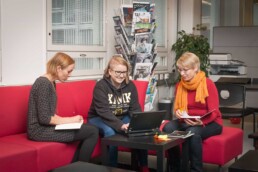
We moved our workspace to the cosy Njetwork Inn, where companies work close together, but in their own space. Working with partner companies under the same roof is now smoother than ever.
The fact that there is only one floor to climb from street level to the office, instead of four, is not unimportant to the basic nerd.
The location in Heinäpää in Oulu is also ideal for guests arriving by car, and it is convenient for us to come and go from here.
Njetwork Inn is a great co-working space. In addition to the company's own space, there are meeting rooms, a kitchen and common areas for a more relaxed stay. Basic services, including coffee, are on the house. This way you can concentrate on your work, and when you need a break, you can find good company nearby.
Business-to-business cooperation starts when people get to know each other
The underlying idea at Njetwork Inn, according to owner Jan Schmidt, is that those who come to work at Njetwork Inn join a multidisciplinary community. The Njetwork Inn community is made up of companies from different sectors, people with different skills and different cultural backgrounds.
Each company's own know-how is extended by the expertise available in the community.
Njetwork Inn has already developed new products and services through multidisciplinary cooperation. According to Schmidt, there has been no need to actively promote this.
Cooperation starts naturally when people get to know each other.
The benefits of the Inn also with a day pass
You can also come to Njetwork Inn to work for the day. The affordable Day Pass allows freelancers and other freelancers to work in peaceful working conditions. The experience of being part of a work community and the opportunity to separate working time from the rest of their lives are also valuable for Day Pass users. Often you can also find someone in the same field with which you can compare notes.
The Njetwork Inn Day Pass is also used by those who come to Oulu on business and need a quiet working space as part of their day.
There's always time for a cup of coffee
Working in a shared space suits kiwis, as MeKiwi's approach is based on trust and long-term partnerships. We always have time to have a cup of coffee and a drink. It is often the most important thing you can do.
Come and have a coffee, says our CEO Jani Kaipainen. Let's wonder about the world and imagine the future!
Come to the inn. It would be nice to see you!
If you can't make it for coffee right now, but have some business, you can find our contact details here. Let's get back to it!